 English
 Tiếng Việt
DNU students overcome challenges in building impressive virtual reality spaces at FAIR 2026.


From digitizing artifacts and building virtual reality spaces to product modeling, 3D image reconstruction technology has many potential applications but still faces challenges due to limited input data. With their MACR-GS research approach, two students from Dai Nam University sought to improve the quality of reconstructions from a very small number of images, with their work being accepted at the FAIR 2026 National Scientific Conference.
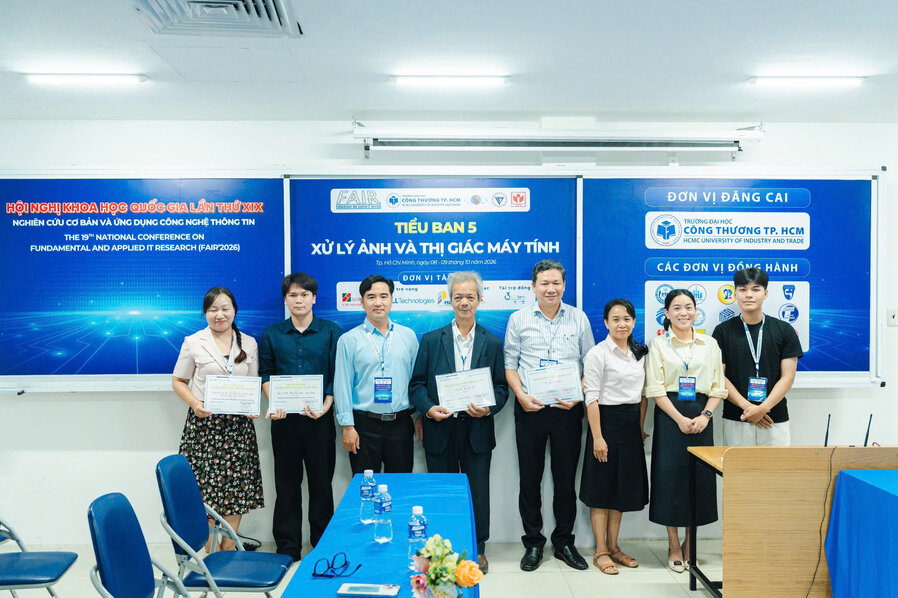
Two students from Dai Nam University researched a problem of reconstructing 3D images from a limited number of input images and were accepted to present their findings at the 19th National Scientific Conference on Fundamental and Applied Research in Information Technology (FAIR 2026).
Solving the 3D reconstruction problem when images are incomplete.
On October 8-9, at the 19th National Scientific Conference on Fundamental and Applied Research in Information Technology (FAIR 2026), the project “MACR-GS: Multi-Anchor Consensus Rendering for Extreme Sparse-View 3D Gaussian Splatting” by Tran Anh Tu (class K17-01) and Tran Minh Nghia (class K17-04), Faculty of Information Technology, Dai Nam University, was accepted.
The research focuses on a challenge in the field of artificial intelligence (AI) and computer vision: how to reconstruct three-dimensional (3D) images when there are very few images taken from different angles.
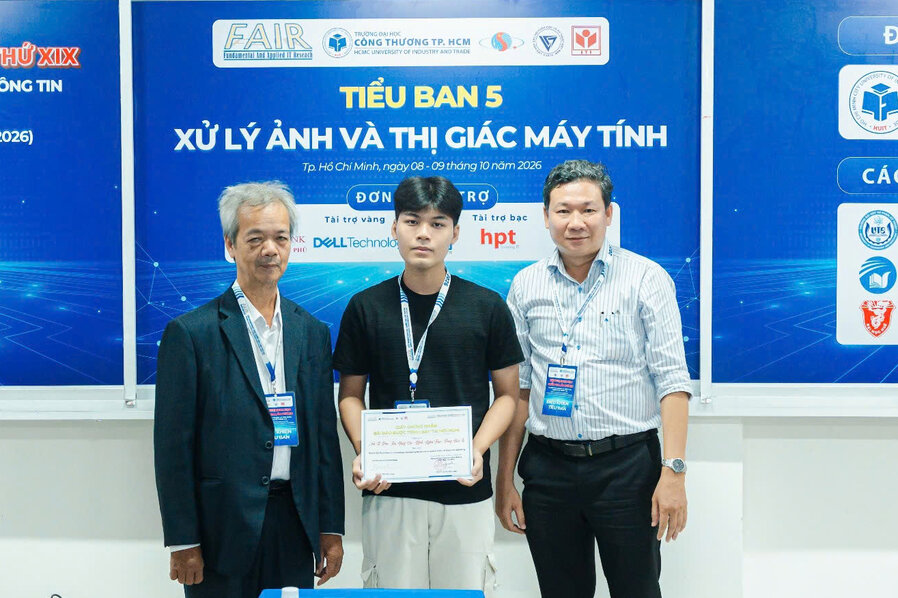
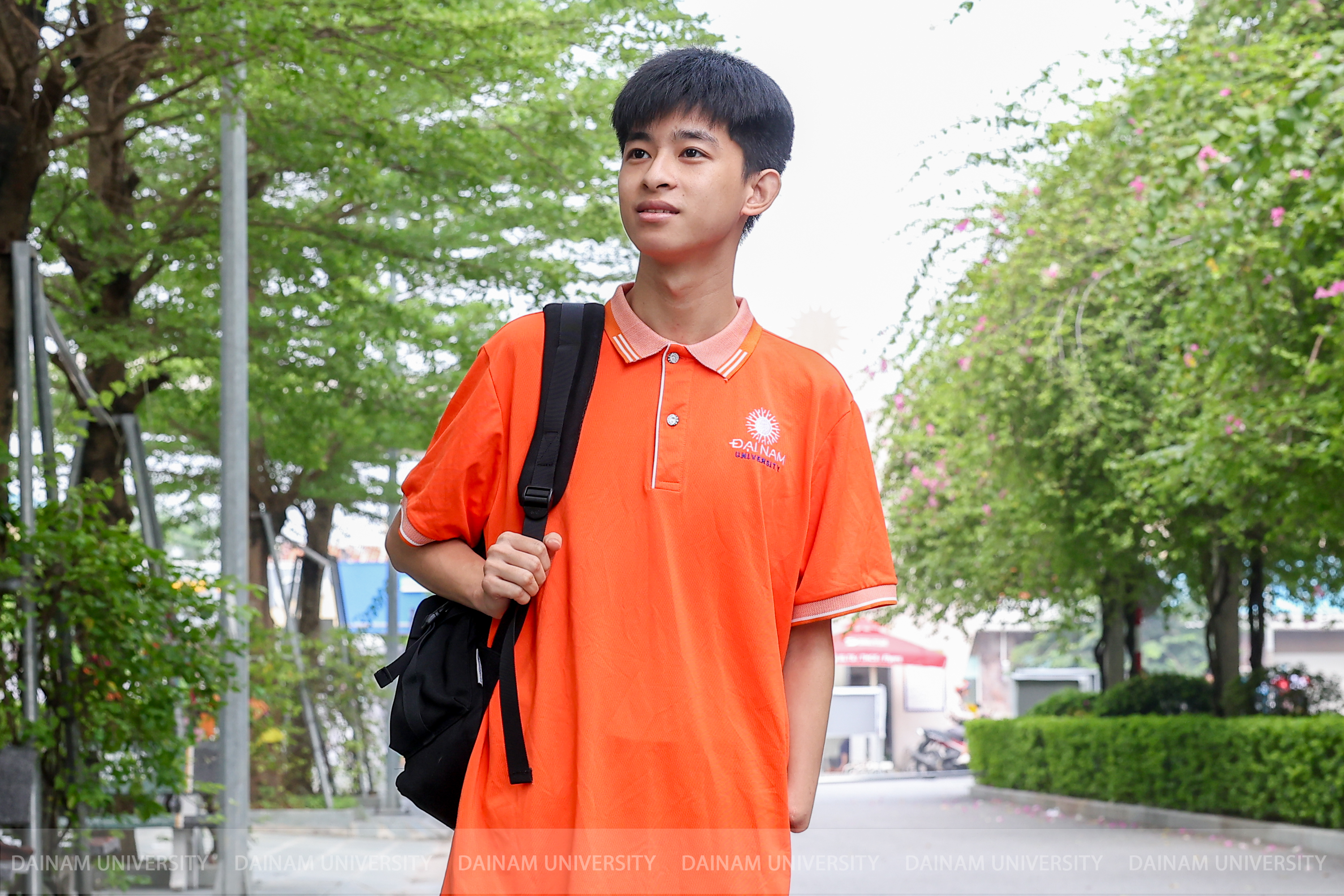
Student Tran Minh Nghia (class K17-04) represented the research group and presented at the 19th National Scientific Conference on Fundamental and Applied Research in Information Technology (FAIR 2026) their work on MACR-GS, aimed at improving the quality of 3D image reconstruction under limited input data conditions.
Typically, to reconstruct a 3D object or space, a computer needs many images as input data. When the number of images is small, details are hidden or not recorded, leaving the system lacking information about shape and depth. Therefore, the model created may be distorted or not accurately reflect the original structure.
3D Gaussian Splatting (3DGS) is a method used in 3D spatial reconstruction. However, with limited image data, creating high-quality models, especially from unrecorded perspectives, remains a challenge.
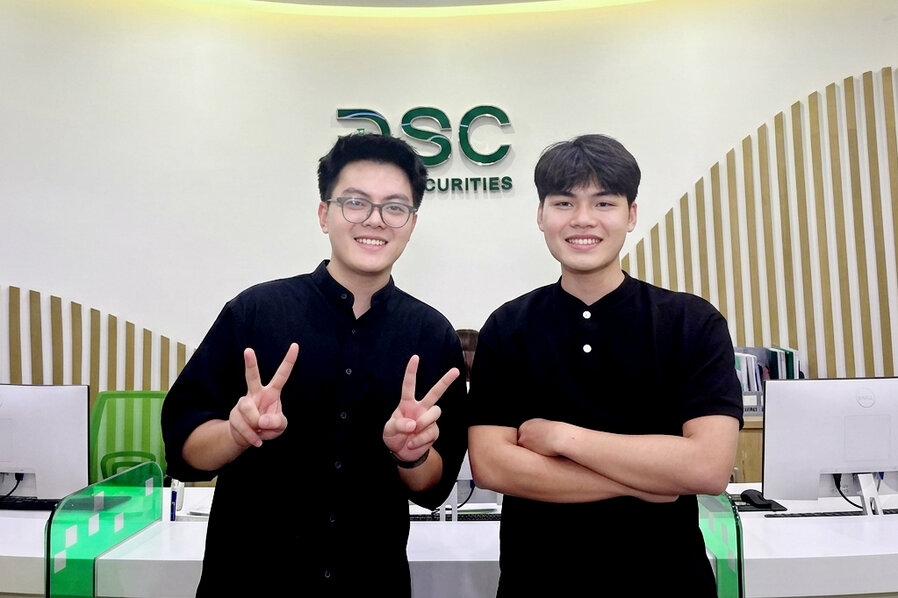
Tran Anh Tu (class K17-01) and Tran Minh Nghia (class K17-04), Faculty of Information Technology, Dai Nam University, had their research project accepted at FAIR 2026.
With the topic of the DNU student group's project, aimed at solving the above problem, according to the experimental results reported by the group, the method shows the potential to improve reconstruction quality from new perspectives, both in terms of structure and visual perception. This is a preliminary result and needs to be further verified on many different datasets and real-world conditions.
This research direction could open up possibilities for developing applications such as digitizing artifacts, building virtual reality spaces, and product modeling. However, for fields requiring high precision, the technology still needs thorough evaluation before being put into use.
Speaking on behalf of the research team, student Tran Minh Nghia said that their interest in AI and computer vision motivated the members to choose the topic.
“We want to delve deeper into how AI solves the problem of 3D reconstruction when data is incomplete. The research also helps us access technological issues with potential applications in virtual reality, object digitization, and technology product development,” Nghia shared.
From reading the documentation to verifying the results.
To complete the project, Tran Anh Tu and Tran Minh Nghia had to go through a research process ranging from studying specialized literature and understanding algorithmic principles to implementing the program, organizing experiments, and analyzing the results.
The difficulty lies in the fact that, with too little input data, the team doesn't have enough information to directly observe all the details of the object.
The reconstruction results also need to be carefully evaluated to determine whether the method actually improves quality. This requires students to go beyond simply making the program work, but to understand the reasons behind the results and have a basis for explaining their findings.
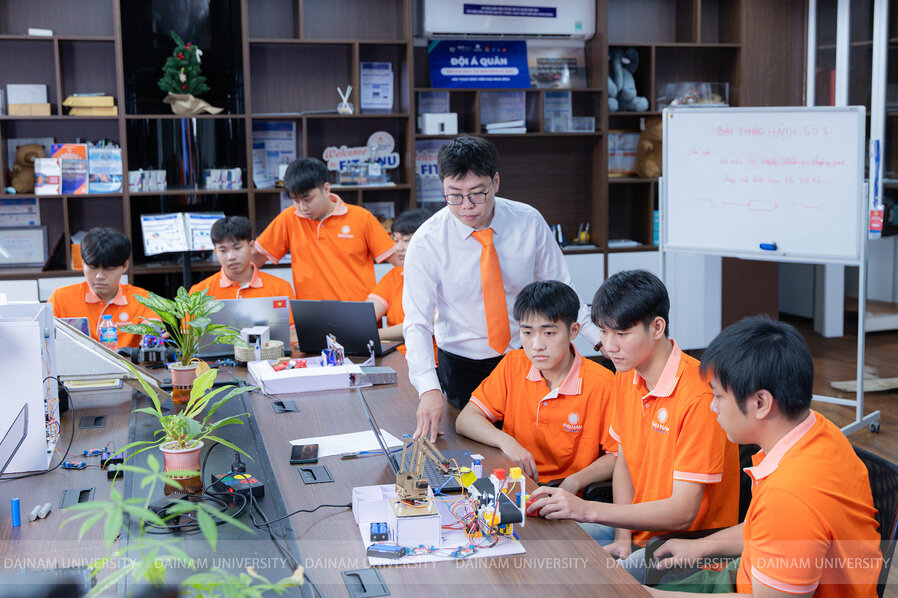
Dr. Le Trung Hieu, Deputy Head of the Faculty of Information Technology, guides students in various scientific research activities.
According to Dr. Le Trung Hieu, Deputy Head of the Faculty of Information Technology, the most valuable aspect of this process is the change in students' research mindset.
“What makes me happiest is seeing the students gradually change their approach to problems. Initially, it might just be finding ways to make the model work, but gradually they have to learn to ask questions, verify results, and find their own solutions. Scientific research is not always smooth sailing, and it is the process of overcoming those difficulties that helps students mature,” shared Dr. Le Trung Hieu.
Throughout the research process, instructors provide professional support, guide methodology, and work with students to analyze emerging issues. The role of guidance does not replace the students' own research, but rather helps them learn to ask questions, choose methods of verification, and gradually develop scientific arguments.
For the two students, having their work accepted at FAIR 2026 is a memorable milestone in their studies. It's also an opportunity for them to access an academic exchange environment, hone their self-learning skills, critical thinking, teamwork abilities, and present their research findings.
Scientific research linked to professional competence.
In the field of information technology, specialized knowledge must be accompanied by the ability to solve problems and verify results. As AI becomes increasingly widespread, understanding how the technology works, identifying its limitations, and evaluating the reliability of its output becomes even more important for learners.
Through MACR-GS research, students have the opportunity to apply their knowledge to an in-depth problem, become familiar with the research process, and practice a systematic approach to problem-solving. This is considered another milestone of success for the Faculty of Information Technology - Dai Nam University, as students continue to make significant achievements in academic competitions.
Previously, the student team consisting of Nguyen Phuc Bang, Dinh Ngoc Chinh, and Doan Mai Lan won first place in the University category at Build@HUB Hackathon 2026; and the Special Prize in the "Technology Innovation Talent 2026" competition...
BTT




Register for admission consultation 2026
scholarships and tuition support worth up to 55 billion VND

scholarships and tuition support worth up to 55 billion VND

