 English
 Tiếng Việt
International OPC 2026 Scientific Conference at Dai Nam University: Connecting scientists from 7 countries.


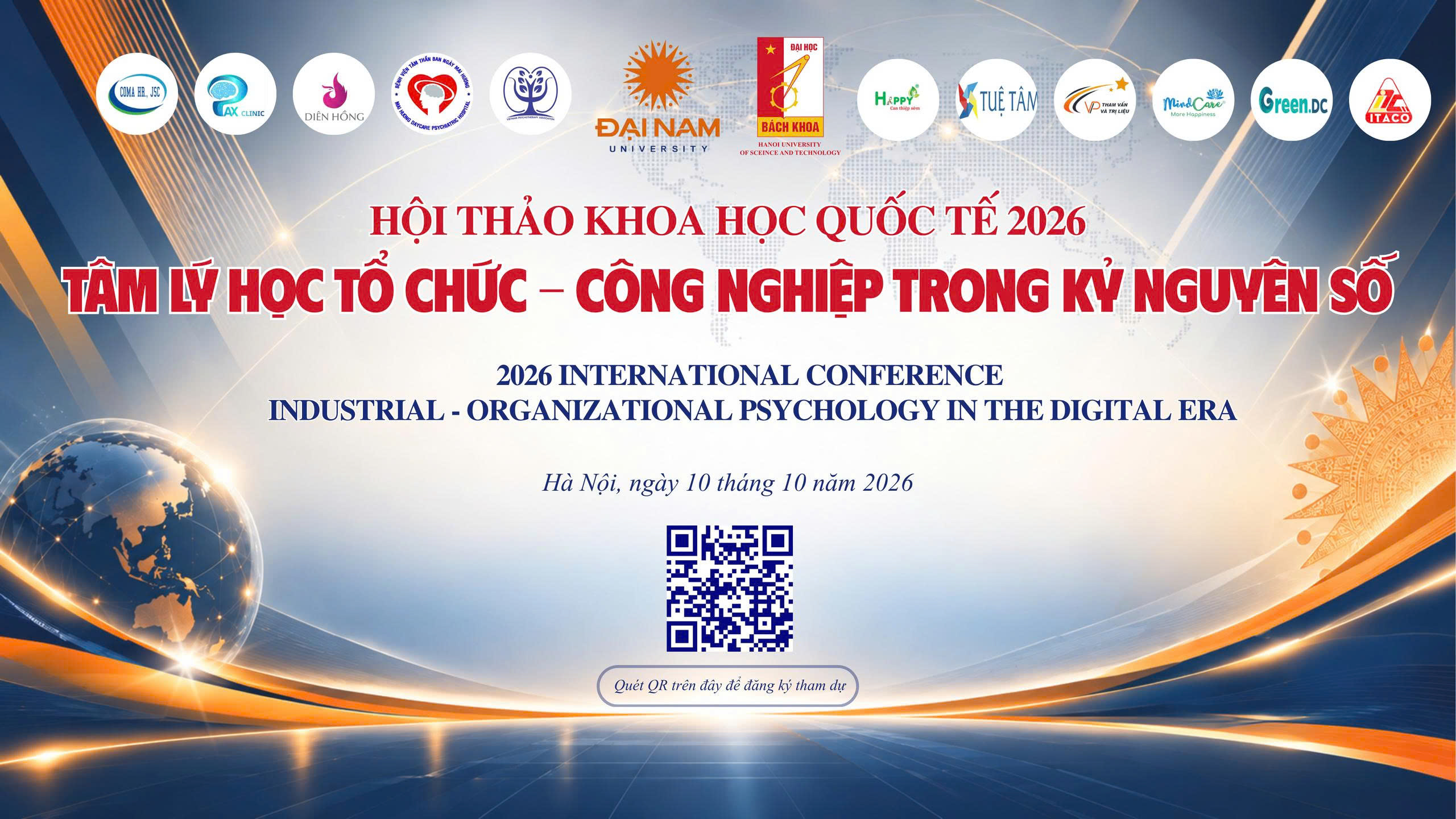
On October 10, 2026, at Dai Nam University, the International Scientific Conference “Organizational Psychology - Industry in the Digital Age” (IOPC 2026) brought together scientists and experts from seven countries: Israel, Canada, Italy, India, China, Russia, and Vietnam. Co-organized by Dai Nam University and Hanoi University of Science and Technology, the conference focused on a major question: As artificial intelligence (AI) increasingly performs tasks replacing humans, what are the capabilities and values that will help people adapt and thrive in the future?
As AI transforms jobs, psychology helps us understand people.
AI is changing the way people work, make decisions, and interact within organizations. The technology can process data faster, automate many tasks, and improve productivity. However, technology cannot solve all the problems related to human motivation, emotions, adaptation, and relationships.
That is also why Organizational and Industrial Psychology is becoming increasingly important. This field studies human behavior and psychology in the workplace, from recruitment and personnel development to leadership, motivation, mental health, and professional performance.
At IOPC 2026, scientists approached these issues from multiple perspectives.
Dr. Sydney Engelberg (Israel) discussed cognitive science, behavior, and change management in the age of AI. Dr. Pham Kim Anh (Vietnam) analyzed the relationship between power, psychological safety, and leadership roles in a digital work environment.
From a human resource management perspective, Dr. Bradley A. Corbett (Canada) focuses on human data analysis and data-driven decision-making; Professor Enrico Dalla Rosa (Italy) researches advanced assessment tools in personnel selection; and Associate Professor Pham Manh Ha (Vietnam) introduces the application of psychometric evidence in career guidance and personnel evaluation through the Career Passport system.
Besides job performance, the psychological impacts of career change are also a concern. Professor Dr. Le Thi Minh Loan (Vietnam) researched the relationship between the risk of technology replacing jobs and workplace happiness. Professor Dr. Alpana Vaidya (India) addressed job insecurity and the mental health of women in the informal economy.
Studies all point to one important realization: Digital transformation is not just about technological change, but also about changing people. An organization that wants to achieve sustainable growth must simultaneously focus on the productivity, adaptability, and mental health of its employees.
From scientific research to practical problems
One notable aspect of IOPC 2026 is that research is not limited to the business environment but extends to education, sports, and many other professional fields.
MSc. Balamurugan SP (India) approaches the issue of motivation and organizational behavior in technology companies. Assoc. Prof. Dr. Mohammad Noman (China) studies the relationship between leaders, employees, and the organizational context. Assoc. Prof. Dr. Amrita Kaur (China) addresses the role of leadership in responding to psychological pressures in the educational environment.
In the field of sports, Associate Professor Sergey V. Leonov (Russia) introduced the application of digital technology in athlete psychology training, supporting the development of concentration, coping with pressure, and maintaining performance.
Despite approaching the issue from different fields, studies consistently show one common point: Understanding people is crucial for effective organizational operation and sustainable development.
For businesses, these research findings suggest ways to select, evaluate, and develop personnel based on scientific evidence, rather than solely on experience or intuition. Understanding the motivations, behaviors, and psychological needs of employees also helps organizations build a suitable work environment, improve collaboration, and enhance adaptability to change.
For higher education, the issues discussed have direct implications for curriculum and teaching methodology innovation. In the AI era, students need not only specialized knowledge and technological skills, but also critical thinking, adaptability, collaboration, decision-making skills, and a lifelong learning mindset.
These are also the competencies that help learners confidently enter a constantly changing professional environment, knowing how to use technology to enhance their own value instead of depending on it. Therefore, connecting psychological research with training practice contributes to expanding the approach to human resource development, in which professional competence must go hand in hand with the ability to understand oneself, work with others, and adapt to the environment.
The value of the conference therefore lies not only in the research papers presented, but also in its ability to connect scientific knowledge with the practical problems of businesses, schools, and workers.
Dai Nam University - Connecting international knowledge, linking research with training.
Co-organizing IOPC 2026 with Hanoi University of Science and Technology further demonstrates Dai Nam University's orientation towards expanding international academic cooperation, promoting scientific research, and strengthening the connection between the university and professional practice.
Sharing her thoughts on the significance of the workshop, Assoc. Prof. Dr. Dao Thi Thu Giang - Rector of Dai Nam University - emphasized the message "Leading Change - Starting with People," and stated: "Leading change is not just about changing how people work, but also about changing how they think about themselves and their role in the organization."
According to Associate Professor Dr. Dao Thi Thu Giang, resistance to change is not necessarily a negative manifestation, but sometimes stems from concerns that need to be listened to and understood. Therefore, sustainable change does not only come from management decisions, but also needs to be built on a foundation of trust, proactiveness, and awareness of the role of each individual.
This approach highlights the role of organizational psychology in team development, building organizational culture, and enhancing adaptability to the changing work environment in the AI era. When each individual understands their role, feels heard, and believes in the common goal, the change process will have a foundation for creating consensus and long-term growth.
For Dai Nam University, international cooperation is not just about expanding the network of partners or organizing academic events, but more importantly, it is about the ability to transform knowledge, experience, and research results into practical value for training activities, faculty, and students.
The issues discussed at IOPC 2026 contribute to suggesting new approaches for faculty and researchers in developing learners' competencies, while strengthening the connection between higher education and the practical demands of the labor market. The conference also provides an opportunity for domestic and international scientists to exchange expertise, develop new research directions, and expand potential cooperation in the field of organizational and industrial psychology.
The university sincerely thanks the scientists, speakers, and experts who contributed their research, experience, and professional perspectives at IOPC 2026; and acknowledges the dedication of the faculty and students of the Department of Psychology and Educational Sciences in contributing to building a meaningful academic forum, opening up new research and collaboration opportunities.
Technology can drive change, but it is people who ultimately determine whether that change is genuine and sustainable. With IOPC 2026, connecting scientists from seven countries not only contributes to promoting international academic exchange but also affirms the importance of understanding people in organizational development, educational innovation, and building a workforce that meets the demands of the digital age.
BTT





Register for admission consultation 2026
scholarships and tuition support worth up to 55 billion VND

scholarships and tuition support worth up to 55 billion VND

