 English
 Tiếng Việt
Future engineers cannot simply learn technology through textbooks.


CNC, lasers, and robots shouldn't just be concepts students learn from lectures and computer screens. When standing in front of a real machine, watching the technology operate in a real production process, another question arises: Is knowing the principles enough to become a competent engineer?
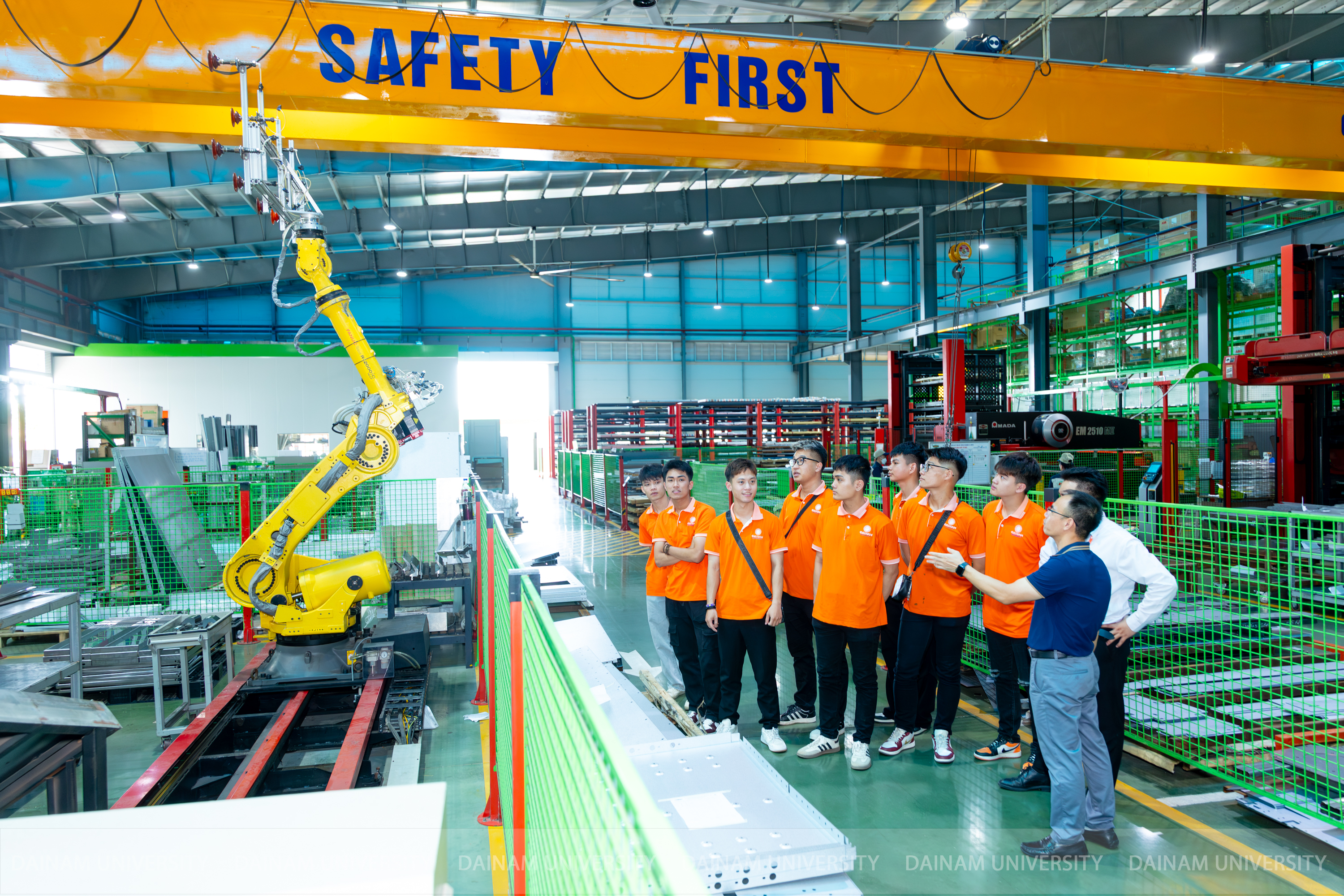
This is also something that students from the Faculty of Electrical and Electronic Engineering Technology - Dai Nam University (DNU) had the opportunity to see more clearly when they directly visited and experienced the Machine Tool Exhibition held at the Exhibition Center, Dong Anh, Hanoi.
From textbooks to actual equipment.
At Bodor's booth, under the guidance of instructors and company representatives, students directly observed laser welding machines, laser cutting machines, laser tube cutting machines, bending machines, and solutions for processing and manufacturing.
What's valuable isn't just seeing a modern device, but seeing how that technology is being put into production.
A principle learned in class becomes more concrete when students stand in front of a machine in operation, observe each step, and ask questions about its structure, control, accuracy, applicability, and underlying technical requirements.
Along with laser technology, CNC milling machines, CNC lathes, and industrial robotic arms, these tools help students better visualize the face of modern manufacturing: machines are increasingly automated, equipment is increasingly interconnected, and the role of engineers is no longer limited to operating a single machine.
From a CNC machine, the story is no longer just about "what this machine is used for," but extends to programming, control, error, and precision.
Standing before a robotic arm, behind its seemingly simple movements lies a complex problem involving control, sensors, equipment coordination, and automation.
Similarly, with laser technology, the underlying principles become easier to understand when seen in a specific machining process.
The question, "Why am I learning this knowledge?" therefore doesn't need an overly theoretical answer. The machine operating right before our eyes already provides part of the answer.
There is a gap between "knowing" and "being able to do."
Seeing the actual machine also helps students realize an important thing: knowing the principles does not mean being able to master the technology.
Businesses don't need an engineer who only knows what CNC is or how robots work. In a manufacturing environment, an engineer must also know how to operate, program, control, read parameters, detect and troubleshoot problems; and understand the relationships between devices in an entire system.
Therefore, what lies behind a CNC machine or a robotic arm is not just one subject. It's a combination of knowledge in electricity, electronics, control, automation, programming, system operation, and the ability to continuously update one's skills with new technologies.
The gap between "having learned" and "being able to work" lies precisely there.
Duc Anh, a second-year student in the Faculty of Electrical and Electronic Engineering Technology, shared: “ Previously, I mainly knew about CNC, lasers, and robots through lectures and computer images. Seeing the machines in operation made me realize that there's still a lot to learn between understanding the principles and actually working with them. I also understand better where the subjects I'm studying will be applied and that I need to increase my practical training .”
Such a realization is perhaps more valuable than memorizing the names of many more types of machines.
Knowing what you lack will help you learn the right things.
A field trip can't turn a student into an engineer. But it can help students see more clearly where they stand on their journey to becoming an engineer.
By observing the technology being applied firsthand, students have a basis to assess what they currently possess and what they lack: whether their specialized knowledge is solid enough; how well their practical skills are; what they need to improve in programming, control, and automation; and whether their specialized foreign language skills are sufficient to read documentation and keep up with new equipment and technologies.
This is also why the Faculty of Electrical and Electronic Engineering brings students closer to technology exhibitions, businesses, and the production environment during their studies.
Lecture halls provide the foundation. Work labs help develop skills. And exposure to machinery, technology, and real-world professional environments allows students to compare what they are learning with the work they will be doing in a few years.
Associate Professor Dr. Do Anh Tuan - Head of the Department of Electrical and Electronic Engineering Technology, stated: “ Technology in manufacturing is changing very rapidly. Therefore, engineering training cannot simply stop at helping students grasp specialized knowledge. Students need to be exposed to real-world technology early on to understand how that knowledge is applied, what skills are required for the job, and thus proactively prepare themselves during their university years .”
Seeing the actual machine is an experience, but understanding the gap between "knowing" and "being able to do" is the crucial lesson for a future engineer.
BTT






Register for admission consultation 2026
scholarships and tuition support worth up to 55 billion VND

scholarships and tuition support worth up to 55 billion VND

