 English
 Tiếng Việt
10 pillars to support a young person's college journey.


Entering university is a major milestone at the age of 18. There's excitement, but behind that excitement are many questions that not every young person has immediate answers to. Did I choose the right major? How should I study and live my university years to avoid wasting time? If I feel discouraged and lost, who should I turn to? Will what I learn in school help me in my career? And after graduation, where will I go?
For parents, these worries become even more concrete when their children first enter a larger environment, begin to be independent, and take responsibility for many of their own choices. Parents cannot accompany their children every day. What they hope for is perhaps not just a place for their children to learn, but an environment good enough for them to gradually mature and have support when needed.
Therefore, university years are not just a journey of accumulating knowledge and credits. They are also a journey for a young person from uncertainty to independence, from not knowing what they want to understanding what they are capable of, from the lecture hall to their profession and future.
At Dai Nam University (DNU), 10 pillars of support for students are also built around that journey of growth.
1. HAVE A ROADMAP SO YOU DON'T GO INTO A DELUSION
At the age of 18, not every student can clearly define who they want to become after four years of university. Entering a new learning environment, young people need not only knowledge, but also a clear direction to know where they are, what they need to develop, and how to prepare for the future.
At Dai Nam University, students are guided on their learning and development path from their early years. In addition to the curriculum, learners gradually identify the competencies they need to develop, the experiences they need to accumulate, and the requirements of their chosen profession.
A clear roadmap helps transform each year of university from a series of consecutive semesters into purposeful stages of development. Students know what they need to focus on, proactively address any skill gaps, and progressively prepare for the post-graduation phase.
Because university is not just about completing a training program. It's also a process of going from not knowing what you want to gradually defining who you want to become and what you need to do to achieve it.
2. HAVING SOMEONE TO SUPPORT YOU WHEN YOU NEED SUPPORT
Leaving high school and entering university is also when young people begin to learn how to be independent. However, independence does not mean having to solve every problem alone.
At Dai Nam University, homeroom teachers and academic advisors accompany students throughout their studies, providing guidance and addressing any issues that arise. These could include struggling with a subject, considering a major choice, experiencing a period of disorientation, or simply needing to be heard and share their feelings.
This support does not replace young people's ability to make their own decisions, but rather creates a foundation for students to gain more information, perspectives, and confidence before making decisions.
For students, knowing they have someone to turn to when needed is an important part of the maturation process. For parents, it also provides peace of mind as their children embark on a new academic journey away from home.
3. THERE IS SPACE FOR LEARNING, EXPERIENCING, AND GROWING
University life doesn't just happen in the classroom. Learning spaces, practical training, research, sports, and community activities all contribute to each student's experience.
Spanning 10 hectares, Dai Nam University students have access to areas for studying, practical training, scientific research, physical activities, and community interaction.
The value of a university campus, therefore, lies not only in its size or facilities, but also in the activities that take place within it: study groups, collaborative projects, first-time public speaking experiences, and even early life challenges.
After graduation, what remains in the memory of university may not only be a subject or an exam, but also the time when young people learned to live, work with others, and grow.
4. THERE IS AN ENVIRONMENT TO TRANSFORM KNOWLEDGE INTO SKILLS
The goal of higher education is not only to equip students with knowledge, but also to enable them to apply that knowledge to solve real-world professional problems. This requires the learning process to be closely linked to practice.
At Dai Nam University, students have access to practical environments tailored to the specifics of each field. Medical students practice at the preclinical center and other practice facilities; Pharmacy students work in laboratories; Information Technology students access technology in labs; and engineering students practice with specialized machinery, equipment, and systems.
Each field has its own requirements, but they all aim for the same goal: to learn to understand and to practice to be able to do it.
Professional competence is not developed solely through written tests. It is the result of a process of practice, receiving feedback, making adjustments, and repeating until the learner can proactively apply the knowledge.
5. HAVE EXPERIENCES TO UNDERSTAND YOURSELF AND DEVELOP YOUR IDENTITY
At age 18, many young people are still in the process of discovering their own abilities and interests. Not all of these abilities are identified in the classroom.
A student might discover organizational skills by joining a club; realize communication abilities when speaking in front of a crowd for the first time; or explore leadership, research, and creative abilities through a practical project.
With over 30 clubs and a wide range of academic, cultural, artistic, sporting, and experiential activities, Dai Nam University students have more opportunities to challenge themselves, observe their potential, and discover previously unrecognized strengths.
That is also the spirit of the message "Unleash your identity - Illuminate your journey" : education does not aim to create identical young people, but to provide opportunities for each student to identify their abilities, develop their strengths, and build a path that suits them.
6. HAVE A BALANCED AND HEALTHY COLLEGE LIFE
Growing up during college is not just about accumulating knowledge. Young people also need to learn how to take care of their health, manage their emotions, build relationships, and adapt to a new community.
Students at Dai Nam University can choose from a variety of physical activities such as martial arts, yoga, dance, football, and many other group, sports, and community activities.
These activities contribute to a more balanced university life, helping students maintain their health, reduce academic stress, and build social relationships.
Because university shouldn't be remembered solely for its schedule, exams, and grades. A fulfilling university journey should help young people learn better, live healthier lives, and be more confident in their communities.
7. OPPORTUNITY TO INTERACT WITH THE WORLD RIGHT IN THE CLASSROOM
As young people begin to understand themselves, they also need to broaden their perspective on the world.
Over 500 international students from India, Bhutan, China, the United States, South Korea, Japan, and many other countries have been studying and interacting at Dai Nam University, contributing to the formation of an increasingly multicultural environment.
A conversation in a foreign language, a friend from a different culture, or an international exchange activity can all be experiences that help students understand differences and learn how to communicate in a diverse environment.
Integration, therefore, doesn't necessarily begin with a long journey. Sometimes, it starts with stepping outside of one's own familiar boundaries.
8. EARLY CAREER OPPORTUNITIES
Understanding yourself is one step; understanding your chosen career is another. If students only start researching practical work in their final year, they may not have enough time to acquire the necessary skills.
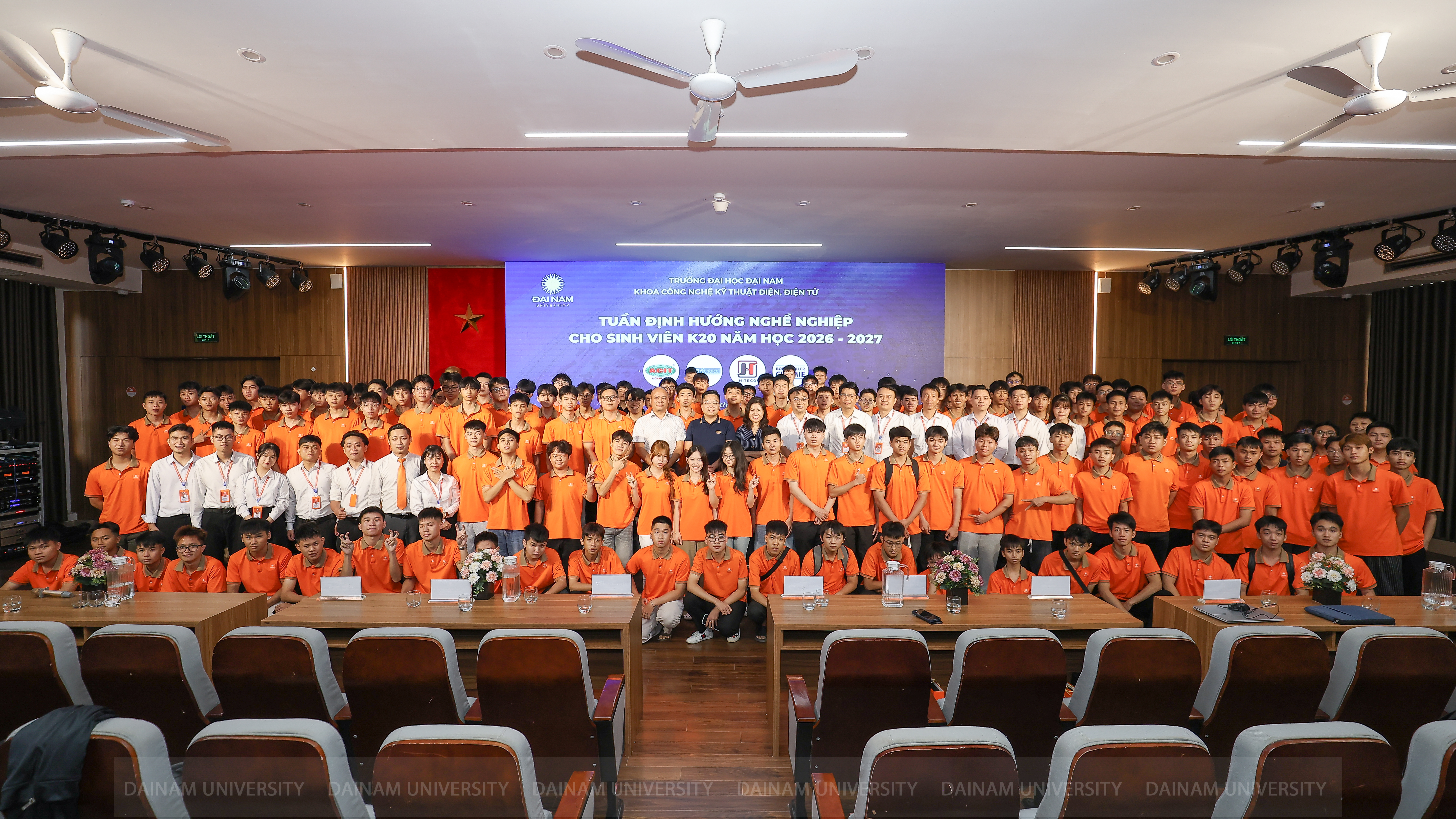
At Dai Nam University, students are connected with businesses from an early stage through visits, seminars, workshops, career experiences, internships, and recruitment matchmaking programs.
Practical experiences help students gradually answer three important questions: What do businesses need? What do I have? And what do I still need to add?
Early exposure to the professional environment helps students adjust their studies, choose suitable experiences, and proactively prepare for the post-graduation phase.
9. HAVE THE RIGHT TO CONTROL YOUR TIME AND FUTURE PLANS
Once young people have identified their goals and know what they need to prepare, they begin to develop the ability to manage their time and make choices for their future.
With suitable training programs, students at Dai Nam University can complete their studies 0.5–1 year earlier. This shortened study time can help students access the labor market sooner, gain experience, and be more proactive in their career planning.
However, the value of being proactive lies not just in the number of semesters shortened. More importantly, it's about the ability to plan independently, make choices, and take responsibility for your own decisions.
The transition from a freshman needing step-by-step guidance to a young person capable of independently planning their studies and career is a significant maturation process.
10. PREPARATIONS ARE BEING MADE FOR THE DAY I LEAVE THE CLASSROOM.
Then the college years will come to an end. At that point, the question for both students and their families will not only be, "Have you graduated yet?", but also, "What will you do after graduation?"
Dai Nam University aims for 100% of its students to be connected with jobs before graduation through its network of businesses and recruitment activities.
The goal of career placement is to ensure that the preparation process doesn't begin on graduation day, but is built throughout the years of study: from specialized knowledge, skills, and practical experience to the ability to adapt to the work environment.
Because the destination of higher education is not just the graduation ceremony. More importantly, when young people walk through the gates of university, they can carry with them the knowledge, skills, experience, and confidence to begin their professional lives using their own abilities.
FROM A CLUMSY YOUNG PERSON TO A YOUNG PERSON WHO CAN WALK ON THEIR OWN.
Looking back at the 10 pillars of the university journey, what matters is not how much a university has to offer, but how those values are present in the learning, experiences, and growth of each student.
It offers a clear learning path to help learners define their goals; support from instructors and the school when guidance is needed; a learning environment closely linked to practice so that knowledge gradually transforms into competence; and experiences that help students better understand themselves, their careers, and future choices.
That journey also requires an environment where young people can develop in a balanced way, both physically and mentally; opportunities for international exchange to broaden their horizons; connections with businesses to gain practical career experience; and the empowerment of students to proactively choose and prepare for their own future.
Ultimately, the value of a higher education is measured not only by what students learn in the classroom, but also by what they can do after graduating.
Four years ago, parents might have brought to school a girl or boy who had just turned 18, still feeling bewildered by the new environment, not yet fully understanding themselves, and not yet clearly envisioning their future career path.
Four years later, the most anticipated thing is not just that the child holding a graduation certificate in their hands.
More importantly, it's about a young person who has a better understanding of themselves, knows what they are capable of, has identified the path they want to pursue, and possesses sufficient knowledge, skills, experience, and confidence to take responsibility for their own choices.
From a young person being dropped off at school by their parents to a young person who can walk on their own – perhaps that is one of the most significant values that the college journey can offer.
BTT






Register for admission consultation 2026
scholarships and tuition support worth up to 55 billion VND

scholarships and tuition support worth up to 55 billion VND

