 English
 Tiếng Việt
Inspired by heartbreaking house fires, DNU students developed an early warning system.


The recent series of house and apartment fires and gas leaks have prompted three students from the Faculty of Electrical and Electronic Engineering Technology at Dai Nam University to research a Smart Home system capable of detecting smoke, gas, and fire, and sending instant alerts to users' phones. Their project not only won second prize at the University-level Student Scientific Research Conference for the 2025-2026 academic year but also demonstrates how DNU students are applying their engineering knowledge to solve practical problems in life.
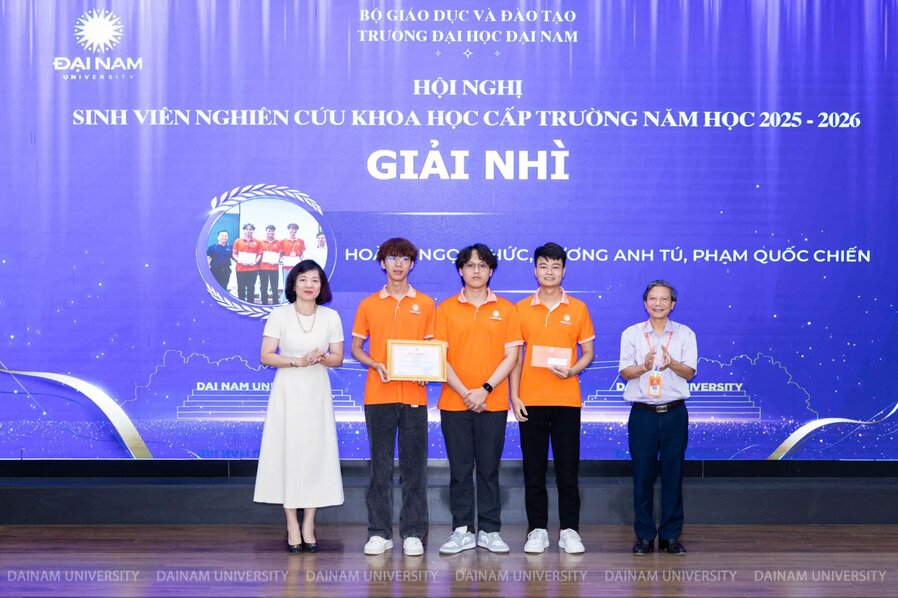
A team of three students, Hoang Ngoc Thuc, Duong Anh Tu, and Pham Quoc Chien, from the Faculty of Electrical and Electronic Engineering, won second prize at the 2025-2026 University-level Student Scientific Research Conference.
Ideas don't come from the laboratory, they come from life.
A fire doesn't usually start with a large flame. It might just be a thin wisp of smoke, a faint burning smell, or a gas leak that goes unnoticed. In many cases, early detection, even just a few minutes beforehand, can prevent serious damage to people and property.
Based on that reality, the group of students including Hoang Ngoc Thuc, Duong Anh Tu, and Pham Quoc Chien posed the question: "What if there was a system that could detect risks early and immediately warn homeowners?"
Instead of opting for expensive commercial solutions, the team aimed to build a more cost-effective system that still ensured effective monitoring and alerting capabilities.
Using the ESP32 microcontroller in combination with gas, smoke, fire, and motion sensors, along with an IoT platform, the team designed a model capable of monitoring the indoor environment in real time. When abnormalities are detected, the system automatically sends alerts to the user's phone for timely action.
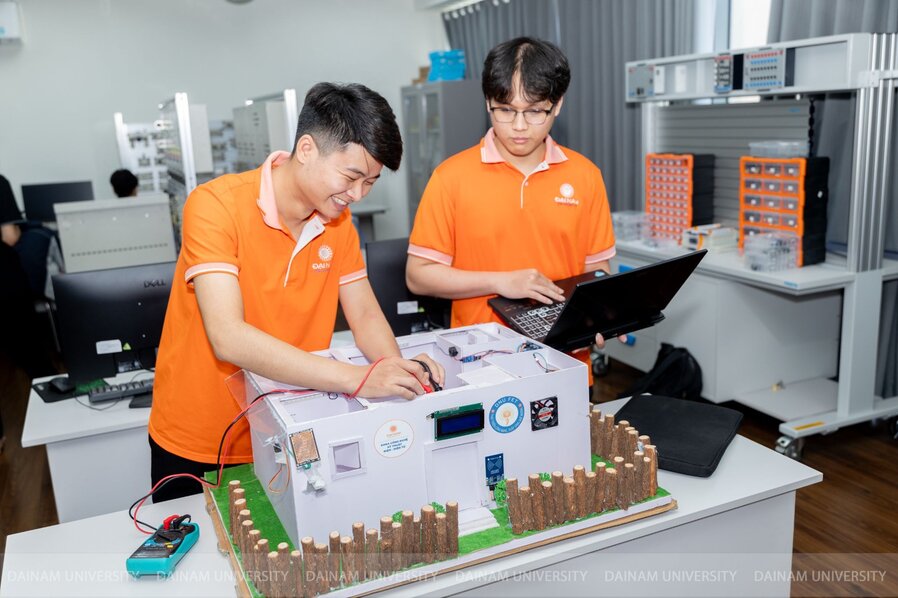
The group of students researching smart home systems have demonstrated outstanding capabilities in detecting hazards and issuing fire warnings.
The hardest part isn't assembling the components.
According to Duong Anh Tu, the biggest challenge lies not in assembling the equipment but in ensuring the entire system operates stably and synchronously.
“Just one faulty link can cause the entire system to malfunction. There was a time when the sensor detected smoke, but the alert signal sent to the app was delayed. Another time, the relay responded incorrectly, forcing the team to recheck everything from the power supply and sensors to the control program,” Tú shared.
In reality, the number of failed experiments was far greater than the team had initially anticipated. There were evenings when the entire team remained diligently working in the lab while many other students had already gone home. There were also solutions that seemed perfect but ultimately had to be reworked from scratch.
However, it was this trial-and-error process that helped the members understand that scientific research is not a straight path to success, but rather a persistent journey of solving small problems one by one.
"Every time we fix a bug, we understand the system better and become more confident in what we're doing," said student Pham Quoc Chien.
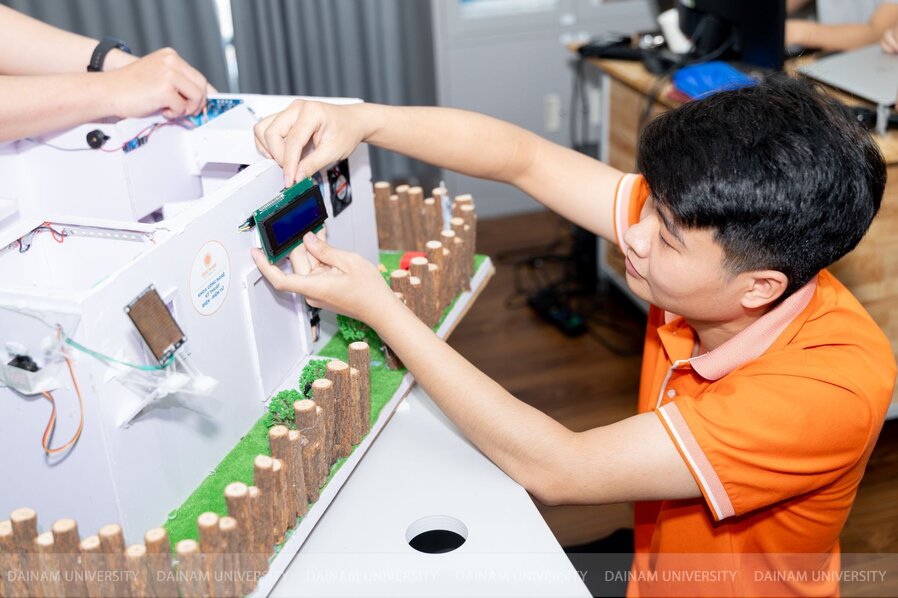
The smart home system, developed by the students using inexpensive components, has the potential for upgrades and integration of artificial intelligence.
The teacher didn't provide the answers.
Accompanying the team throughout the research process was MSc. Nguyen Son Hai, lecturer in the Faculty of Electrical and Electronic Engineering Technology.
According to the members, instead of providing ready-made solutions, the professor often asks open-ended questions to encourage students to find the cause themselves, evaluate the options, and choose the best solution.
This type of guidance not only helps the team refine the product but also fosters research thinking, critical thinking, and problem-solving skills.
According to MSc. Nguyen Son Hai, the greatest value of the project lies not in the Smart Home model itself, but in the process of students independently researching, experimenting, and solving real-world engineering problems.
"Through this project, students will apply their knowledge of electronics, embedded programming, sensors, communication networks, and control systems. These are all skills that businesses currently need," said Professor Hai.
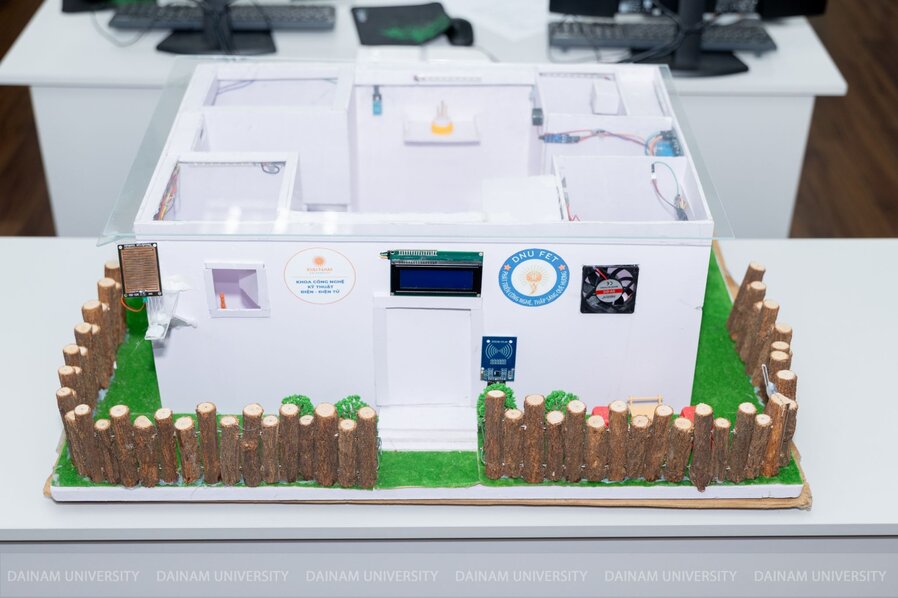
This model could potentially evolve into a low-cost Smart Home kit for educational purposes in the future.
The most valuable thing is not the award.
After winning second prize at the university-level Student Scientific Research Conference, the team continued to refine the system to make it more stable and user-friendly.
For Hoang Ngoc Thuc, Duong Anh Tu, and Pham Quoc Chien, the award is a memorable milestone, but it's not the greatest value that their project brings.
More importantly, they have learned how to transform classroom knowledge into a useful solution for the community; they have learned how to work in teams, how to approach a practical problem, and how to persevere in finding a solution until they achieve results.
From tiny electronic components, failed experiments, and sleepless nights at the circuit board, these students are gradually maturing into engineers who can observe societal problems, ask questions, and use their knowledge to solve those problems.
That is also the training goal that Dai Nam University pursues: not only to train people who are highly skilled in their profession, but also to train people who know how to create value for the community through their knowledge and abilities.
BTT







Register for admission consultation 2026
scholarships and tuition support worth up to 55 billion VND

scholarships and tuition support worth up to 55 billion VND

