 English
 Tiếng Việt
From nights spent reading international papers to the aspiration of mastering "made in Vietnam" chip technology.


While many freshmen are still getting used to the general course schedule and university life, Nguyen Anh Tuan - a student in class TDH DL-1801, International Training Institute, Dai Nam University - has already begun participating in in-depth academic seminars, reading research papers in English, and becoming a co-author of two international ISI/Scopus Q2 publications.
At the age of 18, the male student chose a challenging path: to delve into semiconductor physics, quantum mechanics, and nanotechnology – fields considered the core foundation of the modern semiconductor chip industry.
But what makes this journey special is not just the international publications, but also the way a young student dared to enter the global academic world at a very young age, with perseverance, a spirit of self-learning, and a desire to reach the core technologies of the future.
"YOU MUST LEARN THINGS THAT ARE NOT INCLUDED IN THE CURRICULUM"
Nguyen Anh Tuan describes himself as an engineering student who always yearns to delve into the core principles of technology. This is what led him to choose an international training environment as a way to broaden his thinking and hone his in-depth research skills.
Tuan's journey into scientific research began with academic exchanges with Associate Professor Dr. Nguyen Quang Hoc, a lecturer in the Semiconductor Technology Department at Dai Nam University.
“Through our discussions, the professor noticed that I had a fairly good foundation in physics, so he trusted me enough to invite me to join the research group. The topic of nanostructures and hot electronics was both an intellectual challenge and helped me gain a deeper understanding of the semiconductor industry I am pursuing,” Tuan shared.
But behind those international scientific publications lies a far from easy journey. To keep up with the research team, Tuan had to self-study a range of subjects outside of his curriculum, such as quantum mechanics, statistical physics, solid-state physics, and low-dimensional semiconductor physics – topics that many students only encounter in their final years, or even at the postgraduate level.
“The biggest challenge for me was the knowledge barrier. There were times when I was truly overwhelmed by the overly complex system of equations and wanted to give up. But seeing the dedication of my professor and the seniors in the research group, I told myself I couldn't give up,” the male student recounted.
Behind scientific papers are countless nights of reading English papers, lengthy seminars, and extensive revisions of manuscripts filled with formulas.
TRANSFORMING DRY EQUATIONS INTO THE TECHNOLOGY OF THE FUTURE
Tuan's research focuses on the electronic "cooling" mechanism in nanostructures – a factor considered key to improving the performance of semiconductor chips and next-generation electronic devices.
The male student used an analogy: “Imagine a phone or computer chip as a machine running at full speed. When operating at high power, it generates a lot of heat. If it's not 'cooled' in time, its performance will decrease and the component will fail quickly. My research focuses on how electrons dissipate energy to help future devices run faster, cooler, and more durable.”
These are no longer dry physics formulas, but rather the foundation for a series of important technological goals: miniaturizing electronic components, increasing processing speed, saving energy, and getting closer to mastering "Made in Vietnam" chip technology.
In the context of Vietnam's accelerated development of the semiconductor and integrated circuit industries, research like this is of particular importance to the nation's technological future.
THE TEACHER WHO OPENED THE DOOR TO INTERNATIONAL STUDIES
For a freshman to successfully enter an international academic research environment, it requires not only personal effort but also a mentor who is trustworthy enough to provide opportunities and patient enough to guide them.
Accompanying Nguyen Anh Tuan on that journey was Associate Professor Dr. Nguyen Quang Hoc - whom the student calls the "soul" of the research group.
"He not only answered our professional questions but also inspired us, always dedicated to guiding and motivating us whenever we encountered difficulties," Tuan shared.
According to Associate Professor Dr. Nguyen Quang Hoc, what is valuable about Tuan lies not only in his academic ability but also in his eagerness to learn and his serious attitude towards science.
“Tuan started participating in scientific research very early on, something not many students can do. He is always proactive in searching for materials, has good critical thinking and presentation skills. Becoming a co-author of two international ISI/Scopus Q2 publications is the result of his persistent efforts and active participation in the research group,” Professor Hoc commented.
GROWING UP IN A REAL ACADEMIC ENVIRONMENT
Beyond theoretical research, Nguyen Anh Tuan also participates in many practical technology activities, such as the UAV team of Dai Nam University, having reached the finals of the UAV competition organized by Hanoi University of Science and Technology and participating in UAV training in China.
For two consecutive years participating in student scientific research, Tuan achieved: a Commendation Award at the University level in the 2024-2025 academic year; First Prize at the Faculty level and Second Prize at the University level in the 2025-2026 academic year. But for this male student, the greatest value does not lie in the awards.
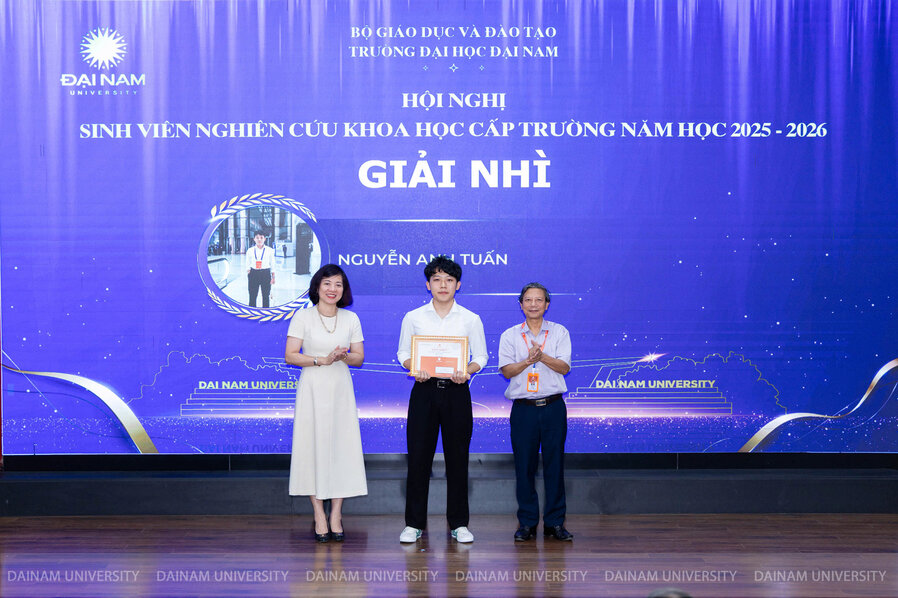
“Scientific research has transformed me from a passive knowledge-absorbing student into an active problem-solving individual. I learned to confront complexity with perseverance, turning dry equations into practical applications. The most valuable thing I gained was not only an expanded knowledge base, but also sharper analytical thinking, professional teamwork skills with senior students, and a solid academic foundation for the future. This journey has helped me mature significantly, giving me the confidence to continue pursuing new research projects and aiming for graduate studies in the future,” Tuan shared.
At Dai Nam University, scientific research is no longer the exclusive domain of final-year students. From their early years of university, students participate in research groups with faculty, graduate students, doctoral candidates, and scientists.
The close guidance of lecturers has helped many students confidently venture into challenging fields, participate in international publications, and gradually master knowledge right from their university days.
"DON'T WAIT UNTIL YOU'RE GOOD ENOUGH TO START SCIENTIFIC RESEARCH"
What's remarkable about Nguyen Anh Tuan's story is not only that he's a first-year student who has already published two international papers, but also his spirit of daring to start very early.
Dare to step into a challenging field when many are hesitant. Dare to face problems that go far beyond the curriculum. And dare to persevere in your academic journey with daily persistence.
The message the male student sent to his fellow students was as simple as his own journey: “Don’t wait until you’re ‘good enough’ or until your final year to start scientific research. In fact, scientific research is the shortest path to excellence. When you tackle a specific problem, you will be forced to learn independently, delve deeper into your knowledge, and mature faster than any lecture in class. Don’t be afraid of difficulties, because it is in the process of overcoming those difficulties that you will find the best version of yourself.”
From those first seminars, nights of reading international papers, and research manuscripts packed with formulas, Nguyen Anh Tuan's journey today is more than just the story of a talented student.
It also represents a generation of Dai Nam University students maturing with research-oriented thinking, self-learning abilities, and a desire to enter the core technology fields of the future.
BTT


Register for admission consultation 2026
scholarships and tuition support worth up to 55 billion VND

scholarships and tuition support worth up to 55 billion VND

